
Improv & Healthy Aging
Theatrical improv offers wonderful benefits for older adults, spanning physical, cognitive, and social dimensions. The Improv for Real Life team offers weekly class series in senior living communities to help residents build community.
We specialize in offering programs that are inclusive of seniors experiencing dementia. Rather than isolating residents with Alzheimer’s or other conditions resulting in memory loss, our classes include residents across independent living, assisted living, and memory care to build community across levels of care.
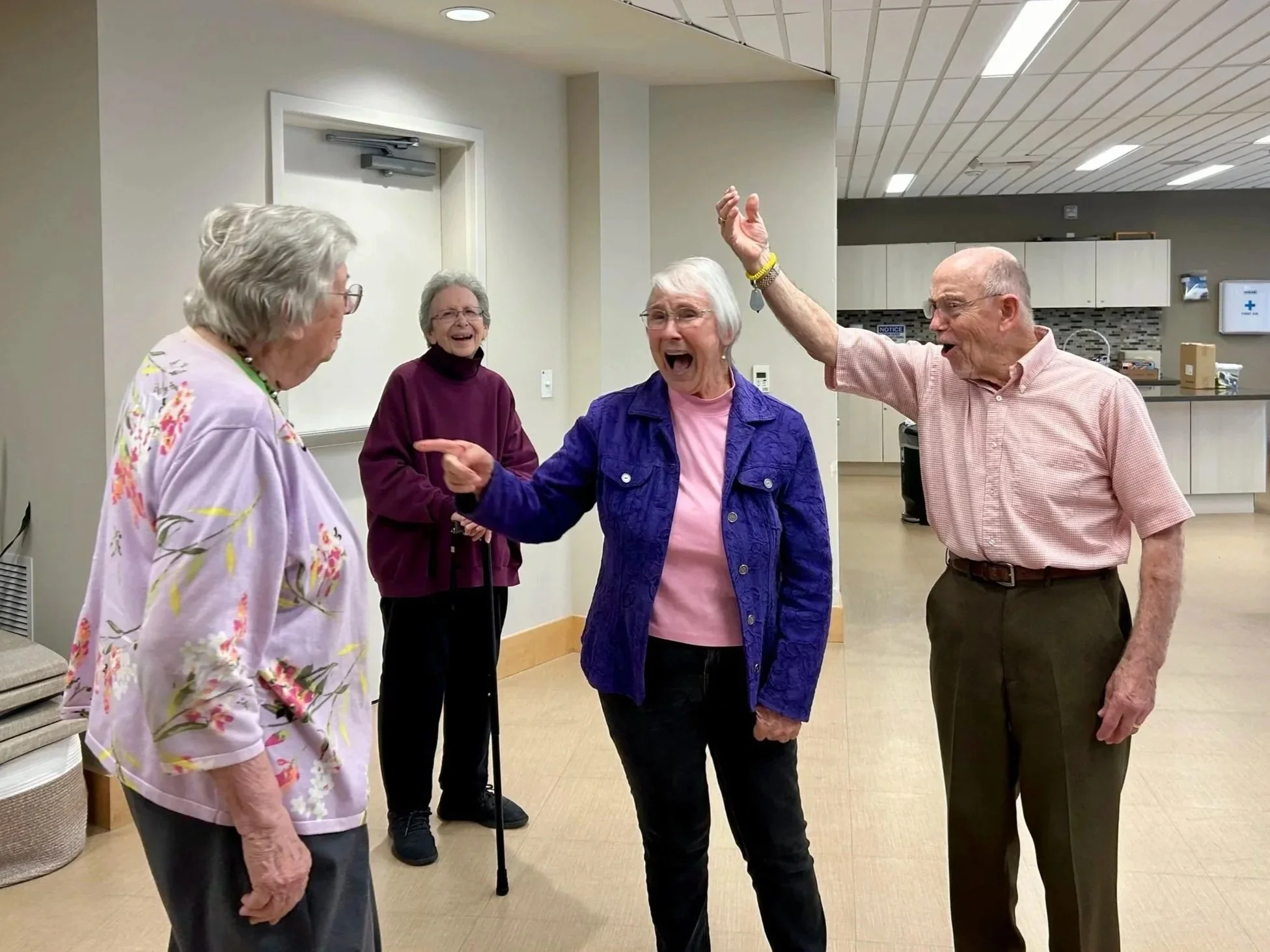
“I’ve never taken the stage in all my life - I’ve been too scared! But this was fun. You were very encouraging.”
Social Connection through Laughter and Play
Community building is at the heart of every Improv for Real Life program, and our classes for seniors are no different. Loneliness is one of the most serious health risks facing elderly populations, and regularly engaging improv can be a particularly effective antidote because it builds bonds rooted in playfulness among participants quickly.
Improv is inherently collaborative — after all, you can't do it alone! For seniors who have lost spouses, retired from careers, or seen social circles shrink, a regular improv class can provide a creative community and a sense of belonging.
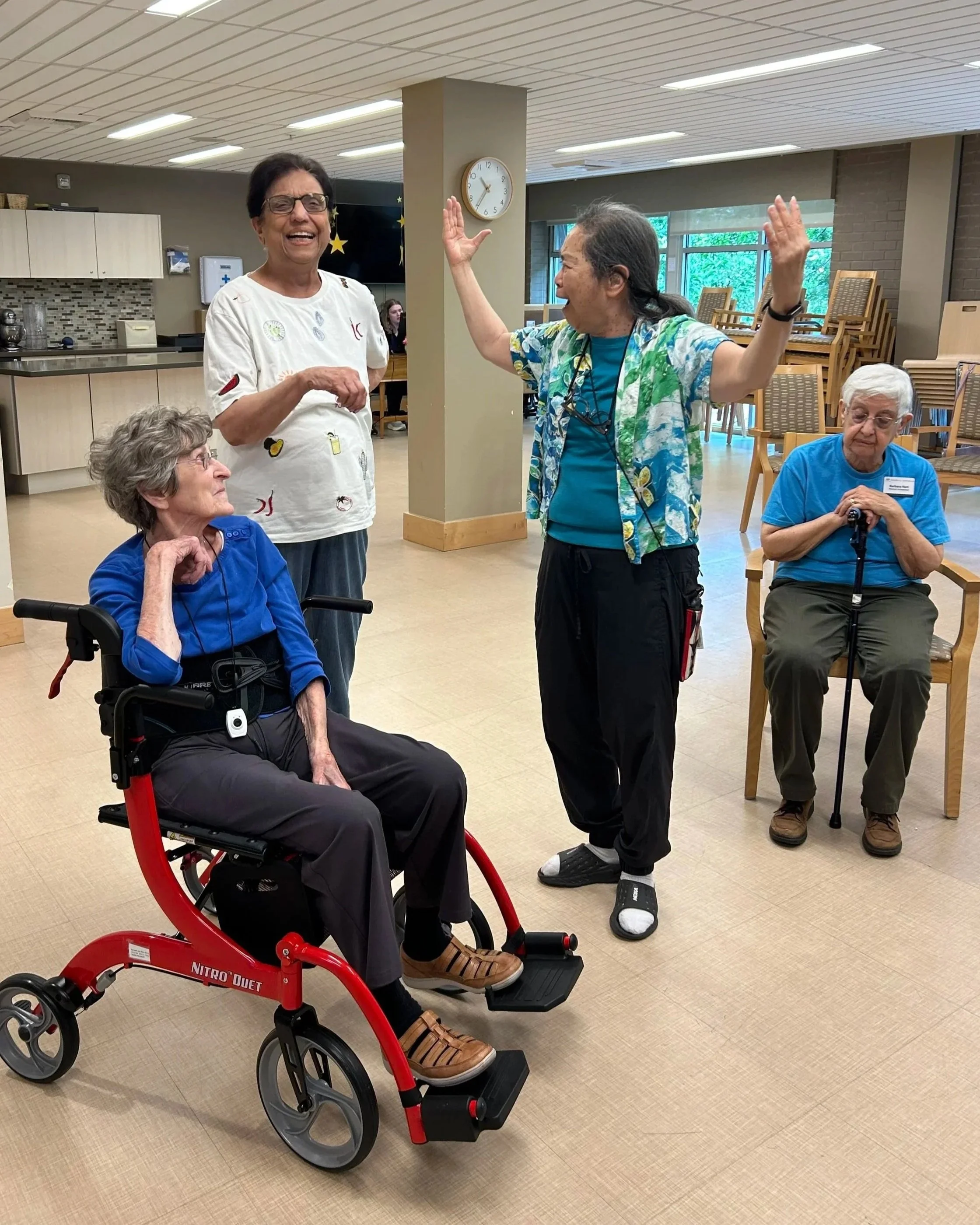
Physical & Mental Accessibility: Helen’s Story
At one of the retirement communities where we teach, we have a regular participant named Helen*. Helen has advanced dementia and uses a wheelchair for mobility: she has lost most of her short- and long-term memory and depends on her gregarious husband, Lenny*, to help her move around the community.
Lenny is an outgoing guy, a former teacher who performed in plays throughout his life — in other words, exactly the kind of guy you’d expect to take an improv class. Helen, meanwhile, is much quieter, and her fellow residents told us that they didn’t see her smile very often.
When Lenny showed up with Helen in tow, some of their fellow residents felt uneasy: they worried that Helen wouldn’t be able to participate, that Lenny was pushing her to try something she would neither be capable of nor enjoy.
Luckily, improv can be inclusive of many types of memory needs. Improv is made up on the spot, and everyone’s ideas are accepted, so it’s hard to be “wrong.”
We were playing a game called “Yes, And” where we imagined that we were planning a summer party for the retirement community. All the game requires residents to do is to accept what the person before them said and then add their own idea. “Let’s host this party outdoors at the beach since the weather is finally nice,” said one of Helen’s classmates. “Yes,” said Helen, “and I imagine a picnic would be nice, so why don’t we pack a basket with some checkered napkins.”
Helen and her neighbors continued to plan an epic shindig to celebrate the summer, complete with a seafood tower, champagne, and a flyover from the Blue Angels. After class, another resident, Carmen, approached our instructor to say, “that’s the most any of us has ever heard Helen say. She can’t remember much, and to be honest, Lenny often talks over her. It was great the way you gave her a specific turn to share her ideas.”
Although Helen may not remember the specifics of what we do in each class, she now shows up smiling every week, feeling confident that she’ll be able to participate.
*All names have been changed for participants’ privacy.
Building Confidence in Your Late 90s: Wilma’s Story
Wilma* was 96 when she first walked into our improv class in her retirement community. (“I’ll tell you how old I am; I’m proud to have made it this far!” she said.)
Wilma thought she was showing up to play bridge (bridge was scheduled right after the improv class), so she was rather dismayed when the Improv for Real Life facilitator, Saya, began to explain what we would be doing that day. Her eyes widened, and before her turn to participate, she would always say, “Well, I doubt I’ll be any good at this.”
But Wilma was hooked. The next week, she showed up again. “Bridge Club is at 11,” Saya reminded her. “Improv Club is meeting now, at 10am.” Wilma nodded timidly. “Oh, I’m aware,” she said. “I wasn’t sure about this last time, but I had a ball. And I’m 96. How many more chances will I have to learn something new?”
Wilma is now one of our most dependable regulars at her retirement home’s weekly Improv Club. Not only that, but Wilma has also taken it upon herself to use lunch hour to try to recruit more of her fellow residents to attend.
“When I was a girl, I was too shy to even say my name when the teacher called the roll. She would always say, speak up, Wilma! and I couldn’t do it. But here you have me playing characters and being okay with being perceived,” Wilma reflected. “I’m nearly a hundred, a fossil for goodness sake, and I’ve become so much more confident. Who would have thought it possible?”
*Name changed for privacy.
Interested in bringing Improv for Real Life to your senior living community? Send us a message and we’ll get back to you as soon as we can!
How does improv benefit senior citizens?
Emotional and Psychological Benefits
Improv creates a low-stakes space to be playful and silly, which can significantly reduce anxiety and depression. Learning to “fail” gracefully and laugh at mistakes builds resilience and reduces the fear of looking foolish that so many people carry. It also reconnects people with a sense of spontaneity and joy.
Communication and Confidence
Learning to think on your feet and express ideas clearly translates directly into everyday life. Many of the seniors we work with report feeling more confident in conversations with fellow residents and better at listening after taking improv classes.
Physical Benefits
Improv involves movement, gesture, and physicality. Even gentle movement helps with coordination and energy levels, and the laughter itself has real physiological benefits! Laughter can reduce stress hormones and even improve cardiovascular function. Our classes are designed to be accessible to seniors with a wide range of mobility levels and needs.
Cognitive Benefits
Improv demands quick thinking, active listening, and staying present in the moment, all of which give the brain a genuine workout. The core principle of improv, “yes, and...” (accepting what a scene partner offers and building on it), exercises mental flexibility and working memory. Regular practice has been associated with improved recall, sharper attention, and stronger executive function. Some researchers have explored improv specifically as a tool for slowing cognitive decline.
Sense of Purpose and Identity
Performing and creating something, even informally, gives people a sense of accomplishment and artistic identity. For retirees especially, having a creative practice that challenges and excites them can be deeply meaningful.